
Nature and Wildlife of the central Spanish Pyrenees – by Crossbill Guides
Naturalists, birdwatchers, ramblers, photographers and all other nature lovers, a warm welcome on this page about the nature and wildlife of the Spanish Pyrenees and neighbouring lowlands in the province of Huesca, Spain. This website accompanies the Crossbill nature travel guide to the Spanish Pyrenees and steppes of Huesca. This is an online Crossbill Guide ‘light’ for the armchair traveller. It offers some general insights and images to warm you up for your stay, plus some practical information, sites and a free route from the Crossbill Guide. Enjoy!
The Pyrenees form a formidable mountainous barrier between France and Spain. The range runs east to west, which means the Spanish part faces south and lies in the rain shadow of de dominant northwesterlies. The central section of the Pyrenees is also the highest part of the range. These ingredients combine to create an Alpine landscape of extremes in very swift succession. It is only a short distance from the permanent snowfields on the high peaks to the low slopes clothed in Mediterranean scrub with semidesert plains at their base. It would be hard to find a place on the continent that such a diversity of landscapes on such a small surface. The same can be said of the wildlife of the Spanish Pyrenees.
Landscape of the Spanish Pyrenees
The Pyrenees are the result of a formidable collision of the Iberian tectonic plate and the much larger European one. The crash zone consists of two large ripples – the high Pyrenees on the border (mountains up to 3000 metres and more) and the slightly lower (up to 2000 metres) and much drier Sierras Exteriores. In the high Pyrenees lies the Ordesa and Monte Perdido National Park with its dramatic glacial valley. The Sierra de Guara Natural Park, famed for its steep canyons, lies in the Sierras Exteriores. In the central valley between the main ranges are the cities of Jaca and Sabiñánigo.

South of the rocky Sierras Exteriores lies the Somontano, a broad belt of rough, dry hillsides, whose name literally means “below the mountains”. Here lies the main city of the region – Huesca. Gradually, as you move further south, the holm oak forest of the Somontano become scrubland and still further south the landscape becomes that of a “Western”, with badlands and table mountains. This is Los Monegros. From the snow-capped peaks of the Pyrenees to semi-desert it is only 130 kilometres.
Alpine meadows and forests of the High Pyrenees
The highest sections of the Spanish Pyrenees form a classic Alpine landscape of murmuring streams and flower-dotted rocky meadows where Chamois graze, Alpine Marmots run around and Golden Eagles and Lammergeiers cruise the skies. The landscape varies from place to place, depending on the bedrock. In the crystalline core of the range you’ll find jagged peaks that are similar to those of the Alps. Around the Ordesa valley however, limestone is the dominant bedrock, which translates into large, rocky but rather flat plateaux, intersected by dramatic gorges and U-shaped valleys, scraped out by glaciers. On these steep slopes are wild forests of Silver Fir and Pine at the highest sections and beech woods further down, which give way to oak woods in the valley.

Sierras Exteriores

On the other side of the valley, the Sierras Exteriores rise again to the subalpine level (roughly 2000 metres) but the scenery is completely different. Being in the rain shadow, the Sierras Exteriores receive much less rain and snow than the high Pyrenees. Add to this a calcareous bedrock into which rains sinks away and you find a mountain range where drought-adapted plants make up the bulk of the vegetation. In the higher parts, a spiny gorse-like plant covers the bedrock – the Hedgehog Broom (Echinospartium horridum). Further down, Holm Oak and Portuguese Oak forests mix with Mediterranean scrubland.
Over time, the small mountain streams have cut out deep and narrow gorges in the soft limestone with a damp and even subtropical climate. The rock flora is very special here.
Like Ordesa, the Sierras Exteriores also abound in spectacular cliffs where many birds of prey breed. Their densities rival those of famous raptor regions like Extremadura and Western Andalucia.

Somontano
The Somontano is less visited by birdwatchers, ramblers and wildlife tourists, except as a gateway into the Sierra de Guara, Riglos and other parts of the Sierras Exteriores. The Somontano is a hilly region, often quite dry and rocky, with holm oak woodlands and scrublands, mixed with fields and almond groves. This region has a classic Mediterranean wildlife, with Hoopoes, Bee-eaters, many orchids and birds of prey that come to hunt here from the nearby mountains. There are a number of wetlands here too, including the Sotonera reservoir where large numbers of Cranes gather in early spring, waiting for the right moment to cross the Pyrenees and travel on to their breeding grounds.

Los Monegros
The wide Ebro basin is shielded from the clouds so effectively that it is, after the country’s south-eastern corner, the driest region of Spain. The Ebro river and its tributaries have formed terraces of sediment which is caked together in the relentless sun. Water and wind sculpted the brittle soil into tablelands and unstable badlands – superbly beautiful to all who love Western-style landscapes, although the cowboy romance is somewhat disturbed by the increasing number of irrigated fields and even rice paddies. Not only the landscape is affected. The birdlife of Los Monegros, once one of the main strongholds for steppe birds in the whole of Spain, is suffering. In particular, the birds that prefer flat steppes and semi-desert, have dropped in numbers.

The finest, most unscathed steppes are those of El Planerón, just south of Los Monegros. Among its wildlife treasures is the rare and very secretive Dupont’s Lark, a species that occurs in northern Africa and just a handful of places in Spain.
The naturalist top 10
Ten highlights of your visit to exploring the Spanish Pyrenees
Ordesa National Park, although busy in summer, offers the most breath-taking scenery of the Spanish Pyrenees. The wide glacial cirque is carved out by a glacier. The wildlife and flora are also extraordinary.

Vultures are virtually everywhere in the Spanish Pyrenees. There are places, however, such as the cliffs of Roldán, where they fly by at eye level.

The steep slopes in the Pyrenees are draped in dense and wild old-growth forests. The beech and pine woods are home to a rare wildlife which includes even such rarities as Brown Bear and White-backed Woodpecker.

The high Alpine meadows are a riot of colourful wildflowers and butterflies.

The semi-deserts have a a unique community of steppe birds, gypsum wildflowers, uniquely Iberian reptiles and desert-dwelling butterflies.

The narrow limestone gorges in the Sierra de Guara and in the high Pyrenees are amongst the deepest and narrowest on the continent. Besides the scenery they boast a unique flora.

Of the area’s many impressive cliffs and mountains, the pillars (Mallos) of Riglos are perhaps the most spectacular. They tower several hundred metres over the small village of Riglos.

The Pyrenees form a mighty barrier on the migration route of Cranes. Many rest at the Sotonero reservoir, waiting for the best weather and wind conditions to cross as they head north.

The soft gypsum, sandstone and clays in the semi-desert lowlands are shaped into spectacular badlands.

Around Benasque you can explore a classic Alpine landscape with snow-covered peaks.


Birds, butterflies and wildflowers – The flora and fauna of the Spanish Pyrenees
The biodiversity of the Spanish Pyrenees and its dry hinterland is enormous. It would be hard to find a richer area in Europe than here. This is obviously a reflection of the large variety in habitats, ranging from the high Alpine zone to the semi-desert plain.
Flora
The two richest wildflower ecosystems on the continent are the Alpine and the Mediterranean. The Spanish Pyrenees combines them both, making this region super diverse.
In the Alpine meadows, you’ll be surrounded by gentians, bellflowers, wild orchids and many other plants of the high mountains. Many are shared with the Alps (like Edelweiss), but some are uniquely Pyrenean, such as Pyrenean Fritillary (Fritillaria pyrenaica) and Pyrenean Dragon’s-mouth (Horminum pyrenaicum).

Some of the finest plants are found on the steep limestone cliffs. Long-leaved Butterwort (Pinguicula longifolia; by the thousands!), Large-flowered Butterwort (Pinguicula grandiflora), Ramonda (Ramonda myconi), Sarcocapnos and Long-leaved Saxifrage (Saxifraga longifolia) are some of the spectacular species on cliffs.
The Mediterranean hillsides are dotted with Holm Oaks and a large variety of shrubs. This is, amongst others, a great area to find wild orchids in spring. Early Spider Orchid (Ophrys sphegodes), Dull Bee Orchid (Ophrys fusca) and Woodcock Orchid (Ophrys scolopax) are common, but there are numerous others, including rare ones like a special variant of the Fly Orchid known as Ophrys subinsectifera.
The steppes have their own drought-adapted flora. It is less showy, but nonetheless interesting for its adaptations to the extreme environment. Perhaps the most conspicuous plant here is the False Esparto Grass, which gleam beautifully in the evening light. Furthermore, there are plants typical of gypsum soils, like Gypsophila hispanica and Herniaria fruticosa, and of saline soils, like Frankenia pulverulenta and nine species of Sea Lavender (Limonium).

Birds
There are few places in Europe (if any) with a higher density of birds of prey. Numbers in the Pyrenees are equal or even exceed those in famous raptor hotspots like Extremadura and Andalucia. The largest and most impressive among them are the vultures. Griffon Vultures are very common, Egyptian Vultures are present in lower numbers and the rarest is the Black Vulture, which has been reintroduced in the adjacent region of Catalonia in is gradually increasing. However, it is a fourth species for which the Pyrenees are most famous – the Lammergeier or Bearded Vulture. Over 50% of the European population breeds in the Pyrenees and the highest densities are found in the central part of the Spanish Pyrenees.

Other birds of prey include Red and Black Kites (both numerous), Golden, Booted and Short-toed Eagles, and Montagu’s and Marsh Harriers.
The high mountains are further home to a series of mostly Alpine species – White-winged Snowfinch, Alpine Chough, Alpine Swift, Dipper, Red-backed Shrike, Ortolan and Rock Bunting, Wallcreeper, White-backed Woodpecker, Citril Finch and even Capercaillie and Ptarmigan. Some of these have become very rare and hard to find though.
In the lowlands, some classic Mediterranean birds are present: Hoopoe, Woodchat and Iberian Grey Shrike, lesser Kestrel, Bee-eater, Cirl Bunting and a variety of Mediterranean Warblers. A scarce but attractive bird of the dry cliffs is the Black Wheatear.
Lastly, the Ebro basin is home to two contrasting groups of birds – the steppe birds in the Monegros and wetland species along the river and some of the lakes and reservoirs. Among the first are sought-after species like Black-bellied and Pin-tailed Sandgrouse, Little Bustard, Short-toed, Lesser Short-toed and Dupont’s Larks. The wetlands support Purple Heron, Glossy Ibis and an assortment of waterfowl. One of the highlights here are the already mentioned Cranes.

Reptiles and amphibians
The reptilian and amphibian wildlife is secretive as it is everywhere, but the area hosts a large number of species. As with the other groups, there are classic high mountain species, such as Pyrenean Brook Newt, Fire Salamander, Pyrenean Frog and Pyrenean Rock Lizard. Much more widespread are Wall Lizard, Iberian Wall Lizard, Ocellated Lizard, Large Psammodromus, Moorish Gecko and a variety of snakes (e.g. Montpellier Snake, Viperine Snake). The hot Ebro basin supports some classic Spanish species like Fringe-toed Lizard, Worm Lizard and Ladder Snake.
Butterflies
The central Spanish Pyrenees are one of Europe’s butterfly hotspots. The richest parts are the high Pyrenees and the Sierras Exteriores. The bulk of the species is concentrated here. And within this area, the Alpine meadows, rocky slopes and dry, south-facing scrublands and grasslands are the very best, not only in diversity but also simply in numbers. Also focus on muddy puddles on the trail – this is where large numbers come down to drink.

The majority of the butterfly species are blues, fritillaries, skippers and ringlets. For butterfly specialists, these are the most interesting groups, as many species are found locally, specialising on a specific habitat or food plant for the caterpillars. Some of them are endemic to the Pyrenees, like Gavarnie Blue (Plebejus pyrenaicus), Pyrenees Brassy Ringlet (Erebia rondui) and Forster’s Furry Blue (Polyommatus fulgens).
More widespread and eye-catching are some of the large species, like Swallowtail and Spanish Scarce Swallowtail, Apollo and Black-veined White.
The steppes and semi-desert have very few butterflies, but there are a few dryland specialities to be found here, such as the very rare Greenish Blacktip (Eucloe charlonia) and Sooty Orange-tip (Zegris eupheme).
Top 10 species
Ten superb plant and animal species of the Spanish Pyrenees
This large raptor of the high mountains is nowhere as easy to find as in the central Spanish Pyrenees. Called bone-breaker in Spanish (quebrantehuesos), it lives almost exclusively of bone marrow, which it collects by dropping bones of dead animals from high up onto the rocks.

This pretty and easily recognizable plant is one of the few European relict species from the Tertiary period (before the ice ages). It grows quite commonly in rock crevices.

The Pyrenees is a European hotspot for butterflies. Among the many flashy species, there are also more modest-looking ones, such as this Forster’s Furry Blue. It stands out though, because of its rarity – it is only found in the Pyrenees.

The Desman is one of the weirdest European creatures, looking like a mole with a short trunk. It lives in rivers in several mountain ranges in the north of Spain and is active only at night.

The majestic Crane breeds in northern Europe and winters in very large numbers in Spain. This means that twice each year these large birds must cross the icy, windy Pyrenees – a perilous journey for these birds. In spring they wait out the best conditions near reservoirs at the foot of the mountains, where they often build up impressive numbers lifting off to cross the mountains.

This secretive lark lives hidden in tussocky scrub in the gypsum steppes in the Ebro basin. It is a very rare bird, occurring only in a few areas in Spain and North Africa. It is one of the representatives of the steppe and semi-desert wildlife in the region.

One of a good number of Pyrenean endemic wildflowers, the carnivorous Long-leaved Butterwort is impossible to miss. It grows on wet limestone cliffs, where it can occur with many thousands of specimens.

The Apollo is another butterfly of the high mountains. It is one of the largest butterflies of the continent and frequents the higher slopes of the Pyrenees.

This plant is endemic to the high mountain meadows of the Pyrenees, where it forms drifts of many thousands of plants.

Together with Extremadura and Andalucia, the central Spanish Pyrenees have the highest densities of this huge vulture in Europe. Especially in the rocky Sierras Exteriores, you can see hundreds of them.


Routes and practicalities
The central Spanish Pyrenees have a peculiar structure, with valleys running from north to south. They start on the flanks of the high mountain ‘spine’ that separates France from Spain and run all the way down via the exterior sierras and further down to the Ebro basin. This means that it is much easier to travel in a north-south direction than across the Pyrenean valleys from west to east. This enables you to see the high mountain landscapes as well as the hot, semidesert lowlands from a single base. You can walk and watch chamois on a snowy mountain slope on one day and watch the sandgrouse flying over the dry steppes on the next – an exceptional situation.
Sustainable tourism
Do
- Inform yourself before visiting a wildlife site (websites, visitor centres, tourist information, etc.).
- Visit local museums and shops and buy local books and produce.
- Use local guides.
- Keep your distance to any wildlife especially to birds and above all in the steppes and high mountains, where birdlife is extra sensitive.
- Watch where you step to avoid trampling flowers or nests of ground breeding birds.
- Bring your rubbish home.
Don’t
- Approach nesting birds (interfering in any way with nesting birds is forbidden by law).
- Catch butterflies and other insects with a net (forbidden by law).
- Pick or remove flowers.
- Trespass on privately owned land
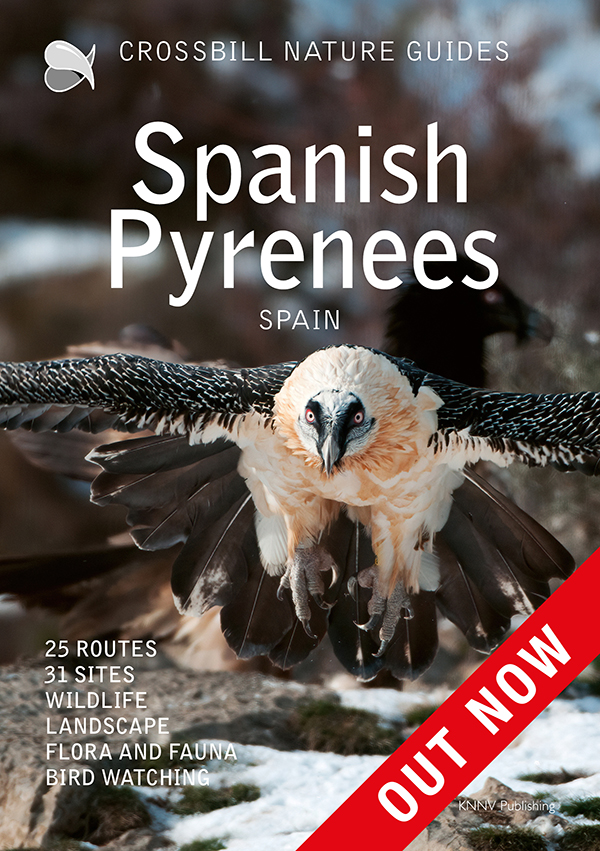
The Crossbill Guide to the Spanish Pyrenees
The Crossbill Guides are the most comprehensive nature travel guides available. Each Crossbill Guide has in-depth descriptions of the landscape, habitats, geology and all the species groups found in each region and links these to routes where they can be seen.
These routes are typically a mixture of itineraries on foot and by car with stops and short walks. Combined, these routes cover all the best sites for mammals, birds, reptiles and amphibians, butterflies, dragonflies and wildflowers. They are also set out to give you the finest examples of the ecosystems and geological features. In short, everything for nature lovers.
The volume Spanish Pyrenees covers all the central Pyrenes in the region of Aragón down to the Monegros and El Planerón (often known as ‘Belchite’ among birdwatchers). It also includes the Laguna de Gallocanta, which lies a bit further south.
- 264 pages
- 25 detailed routes
- 30 site descriptions
The authors
Dirk Hilbers (NL, 1976), set up the Crossbill Guides Foundation and travels Europe to research the guidebooks. This is the 17th guide he worked on. As a biologist, when not in the field, Dirk Hilbers is a free-lance writer and lecturer in the field of nature education and environmental ethics.

Kees Woutersen (NL, 1956) has lived in Huesca for 20 years, working as a nature and bird guide throughout Spain. He runs his own travel company, Aragon Natuurreizen. Kees Woutersen is author of various books on the birds and natural history of the Pyrenees and Aragon, e.g. the Atlases of the Birds of Huesca and Ordesa.
