


Region covered by this Crossbill Guide
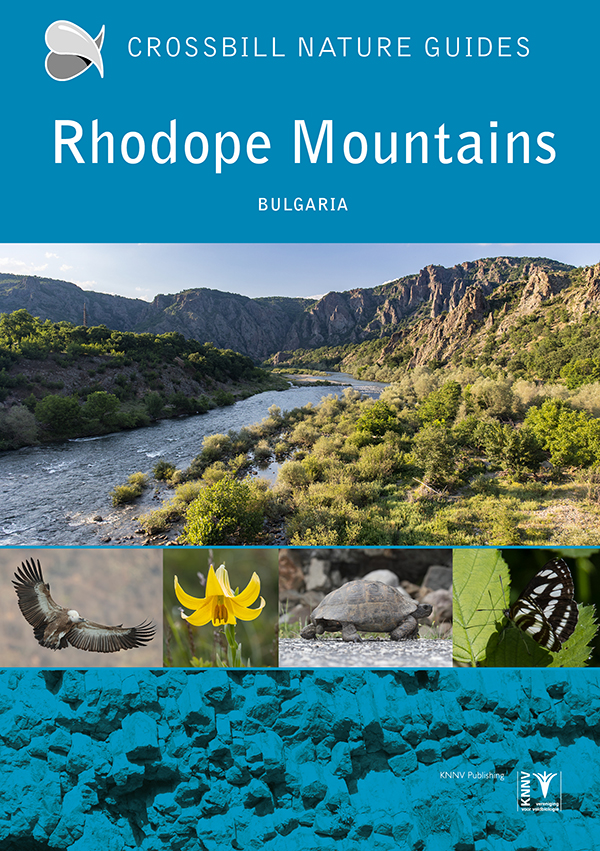
The Crossbill Guide Rhodope Mountains covers the Bulgarian part of the Rhodope Mountain chain that forms the border with Greece. The Bulgarian Rhodope Mountains are often considered to contain two parts, a high and very green western and a lower and drier eastern part. Both are covered in this book.
Additionally, the guide covers two further regions. The first is the broad lowland valley of the Maritsa River, where the cities of Plovdiv, Haskovo and Svilengrad are situated. The motorway connecting Sofia and Istanbul also passes through this valley. The final area covered in this book is the small mountain range of Sakar, which lies just east of the River Maritsa and the border with Turkey. This is a dry region with a steppe-like landscape.
Why visit the Rhodope Mountains of Bulgaria?
The Rhodope Mountains are among the best destinations for birdwatching, wildlife watching and nature travel in Bulgaria. The region is famous for its vultures, eagles, wildflowers, butterflies and large mammals, and is widely regarded as one of the richest wildlife regions in Eastern Europe.
For visitors who want to go birdwatching in Bulgaria, the Rhodope Mountains are a key destination. It is one of the best places to watch vultures and eagles in Bulgaria, indeed one of the best places in the whole of Eastern Europe. Additionally, the wildflowers of the Rhodope Mountains, including many orchids, form another big draw, as do the many reptiles in the area. The region is excellent for walking. It also lends itself to more safari-style exploration in search of wolves, bears, jackals, bison and wild horses.
The western part is heavily forested with coniferous forests (spruce, fir and pine) on the higher slopes, beech and oak forests at lower elevations. It is a wild and sparsely inhabited range where Wolves, Brown Bears and Chamois occur.
The Eastern Rhodopes by contrast, are a little lower, but above all much drier. The climate is much more continental and the vegetation more open, with a mix of open oak woodlands, scrubland and dry, flowery grassland. In particular the Eastern Rhodopes is famous for its splendid birdlife with a mix of Mediterranean, Eastern and Central European species.
The lowlands to the north are fertile and dominated by agricultural land with large rivers and small wetlands, but also steppe-like grasslands. These latter are especially frequent around the Sakar hills, which are another hotspot of eastern and southern wildlife.
For more information on the Bulgarian Rhodopes, visit our Wildlife Site Pages on the Eastern Rhodopes
About the Crossbill Guide Rhodope Mountains
The Crossbill Guide Rhodope Mountains is a thorough and practical guide for birdwatchers, naturalists and nature lovers. It offers background information, routes and site descriptions, plus tips on finding and watching all kinds of wildlife. Each route offers detailed descriptions of where to find wildlife and wildflowers. The book offers a mix of walking routes and car itineraries with stops and short walks. Although some are challenging, all the walks in this book are designed to explore the landscape and find birds and wildlife rather than simply covering ground.
Some key species you may find with this book
- Egyptian Vulture
- Griffon Vulture
- Eastern Imperial Eagle
- Masked Shrike
- Levant Sparrow Hawk
- Wallcreeper
- Rock Nuthatch
- Black Stork
- Suslick
- Golden Jackal
- Rhodope Lily
- Turkish Helleborine
- Bulgarian Emerald
- Apollo
- Small Bath White
About the authors
Dirk Hilbers (NL, 1976), set up the Crossbill Guides Foundation and travels Europe to research the guidebooks. Dirk worked on the first version of this guidebook, together with the Alex, Albert and Herman, and wrote the current version in close collaboration with Stefan Avramov and Polihron Karapachov of Rewilding Rhodopes. As a biologist, when not in the field, Dirk Hilbers is a free-lance writer and lecturer in the field of environmental ethics.
Alex Tabak (NL, 1976) is an ecologist specialised in field surveys of flora, vegetation, reptiles/amphibians and butterflies. He works partly in the Netherlands, and partly in Greece.
Albert Vliegenthart (NL, 1975) works at de Vlinderstichting – the Dutch butterfly conservancy, and is specialised in butterflies and dragonflies, in addition to being a keen birdwatcher.
Herman Dierickx (BE, 1958) is an author who has specialised in writing articles on environmental issues, nature and nature conservation in Belgium.
Reviews
There are no reviews yet.